The Pixel Witch Trials
Religious Crusades Amidst An Industrial Revolution
With the shocking yet not unexpected poor reception of the latest title in the Call Of Duty franchise, avid gamers have taken to the inter-webs to loudly broadcast refunds of their latest purchase. Refunds not because the product is in a sorry technical state at launch, albeit being a critical and narrative failure but because of suspected, now confirmed usage of “AI Art.” One user dramatically proclaiming in his refund request to Steam that Activision failed to disclose use of AI in its latest offering thus drawing his ire necessitating the refund. A few weeks back, Eurogamer, one of the gaming industry’s premier publications proudly docked off score points from their review of Arc Raiders for use of generative AI in some of the voice work. We are rapidly approaching a point where developers will have to supplicate themselves before internauters lest they be subject to the wrath of crusading mobs. It does seem though that those most affected by these crusades are the smaller and independent developers and publishers. Irreligious corporations could care less. Issuing pithy missives they continue in their great adoption of this technology. High costs are anathema. Fealty is only to larger profit margins. Perhaps, the angry chants of the congregation as they bey for blood will stop the inevitable. This is however highly unlikely. What will come to pass will come to pass.
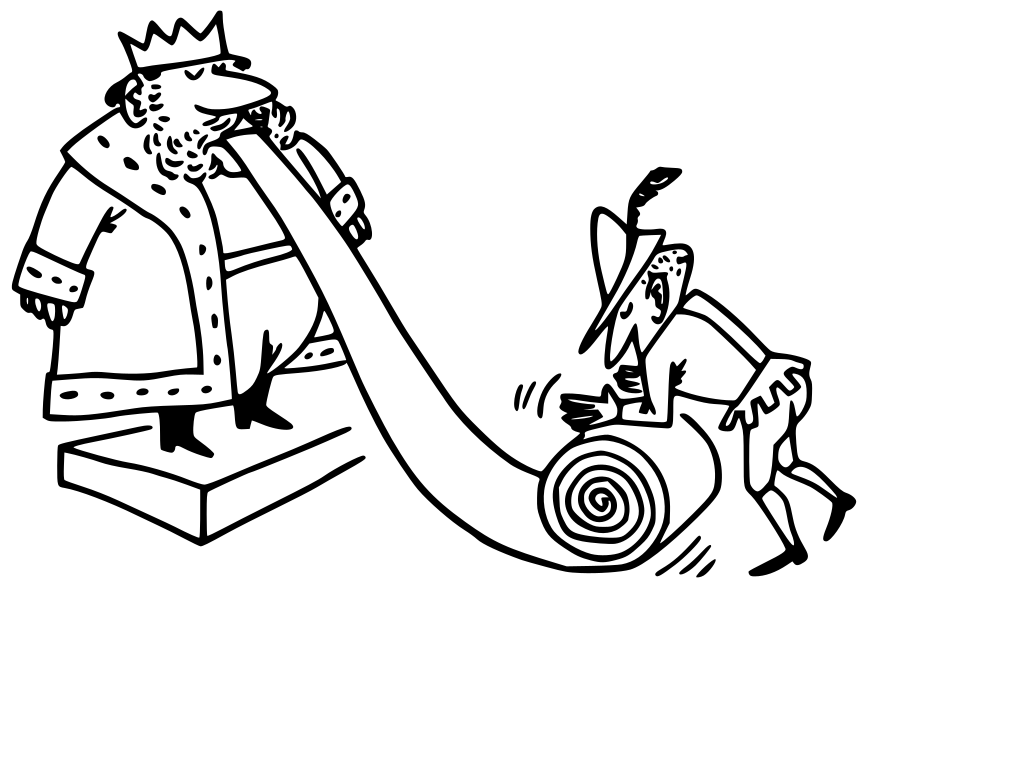
…developers will have to supplicate themselves before users on the internet lest they be subject to the wrath of crusading mobs…
Rather than being welcomed as a new tool to aid in innovation and improve efficiency, some have taken issue with AI technology as companies are opting to replace parts of their workforce with AI agents. South Korean developer Krafton has proudly proclaimed that they are an AI first company investing approximately 63 million euros in the endeavour. NetEase, Activision and others are openly embracing the technology in hopes of quicker turnaround times and lower costs in the long run.
There seems to be a misconception in parts of the populace on the role of private enterprise. These large conglomerates are not a government jobs program which often create jobs for the sake of creating jobs. Businesses exist to create wealth in the long run while generating profits in the short run. These profits are what keep a business afloat. Through these profits companies can then maintain a workforce, innovate, create value in hitherto nonexistent segments of the market and in the communities they serve. Companies cannot and should not be forced to maintain bloat in their workforce especially when segments of that workforce are unproductive.
As AI has been mythologised over the past few years, some assume that these programs and “agents” are able to takeover wholesale the roles and responsibilities held by human beings. This is fiction. There are some rudimentary activities that can be assigned to AI such as arduous tasks. However, complex tasks still need to be guided by human hands. How often in reaching out to customer service does one get hold of a chatbot that is utterly unhelpful ultimately opting to be put through to an actual live agent. It is possible that there are companies who have bought into this myth and are going all in, firing huge swathes of their workforce in pursuit of larger profit margins. They will fail. Ultimately, like any other tool, AI should be in service of the company, its stakeholders and their clientele. If the end product is qualitatively better then adoption should be championed rather than shunned. There are roles in any workforce that do not require opining or much reasoning. Simply effort. If those in said roles spend most of their time opining and dragging the whole operation down rather than working they will in all likelihood get cut. If rather than add value to a business they are a constant source of negations, they will be cut.
AI should be in service of the company, its stakeholders and their clientele. If the end product is qualitatively better then adoption should be championed rather than shunned.

In Fantastic Beasts And Where To Find Them, one of our protagonists, Jacob, would like to receive a bank loan to open a bakery. The bank denies his loan application because according to them, at the turn of the century, there were machines that could produce hundreds of pastries in an hour with a low workforce. His business would simply not be able to compete and the bank may end up foreclosing and incurring a loss. At the end of the films Jacob is shown to be running a successful bakery. While there are some aspects of plot armour pertaining to our protagonist, the reason Jacob was successful wasn’t because he ultimately got funding and is able to out-compete and outsell the donut factories of the day. It is because he was passionate about his craft, was offering something very unique (his grandmother’s wonderful recipes which were a family tradition handed down over the centuries) and had a personal stake in the business. With the developers who have sadly been replaced by AI, how much of the same can be said about them. Are they simply working to collect another paycheque, engage in online activism besmirching the companies they work for or are they genuinely passionate about the craft and are willing to take risks to create and build something magical? The ongoing pixel witch trials assume the answers to all the above is yes. Anyone caught up on recent goings on in the world will know this does not match up to reality. While there was a time and period where we could be forgiven for having blind faith in developers those are days gone. Studios should not bend backwards to provide job security for those not aligned with the goals and objectives of their employers and their clientele especially if being forced to eat up unnecessary losses.
Image credits in order of appearance: Image by OpenClipart-Vectors from Pixabay; Image par Raquel Candia de Pixabay ;